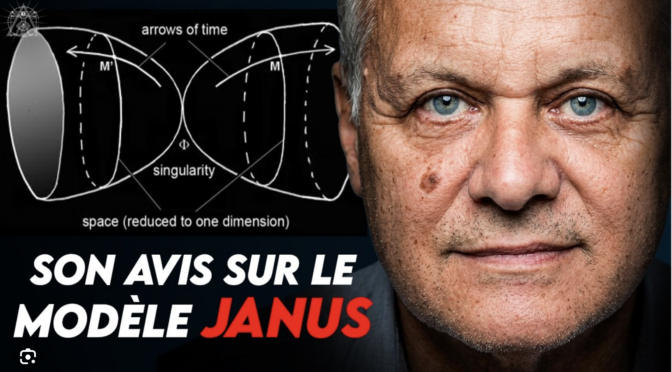
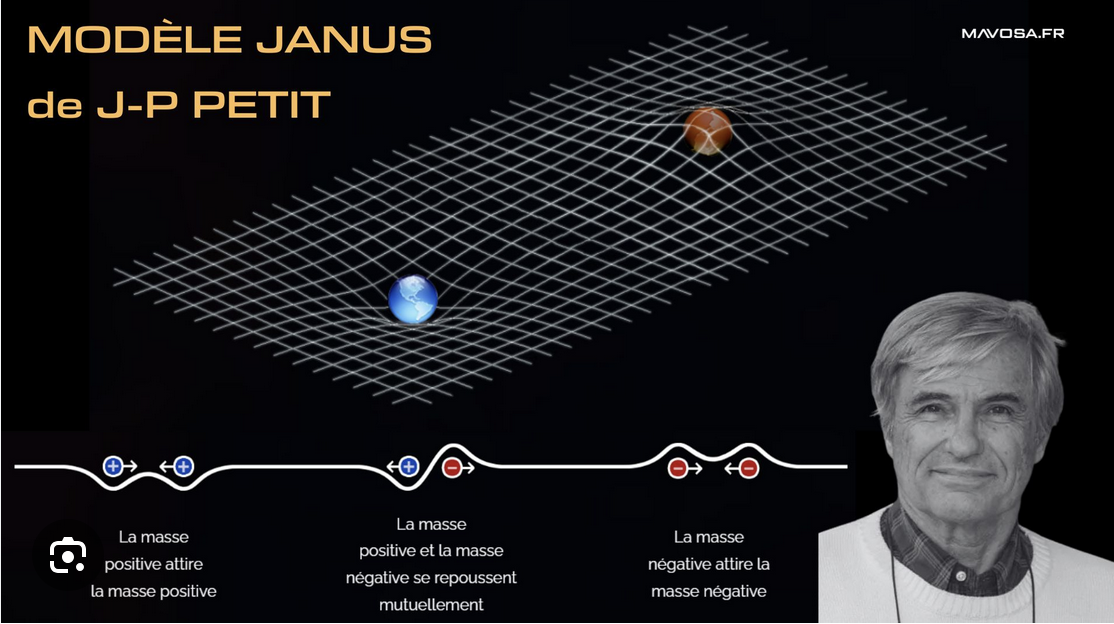
Cela fait plusieurs années que mon collègue Jean-Pierre Petit et ses collaborateurs clament l’inconsistance mathématique et physique des modèles relativistes de trou noir, dans le but de promouvoir leur alternative dite des « plugstars », qui selon eux serait soutenue par leur modèle cosmologique Janus.

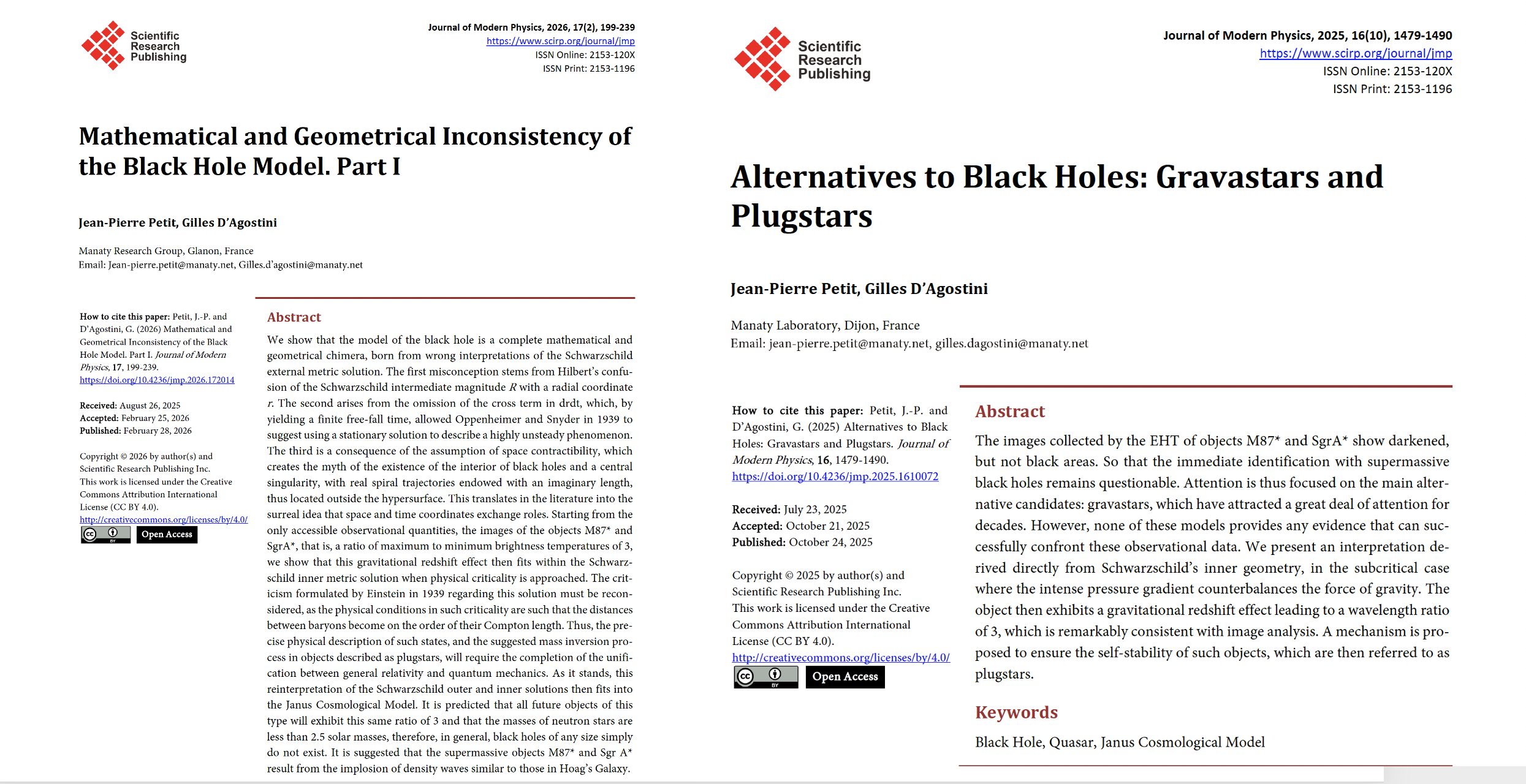
Après s’être heurté durant des années à un rejet de publication de la part des « referees » des grandes revues scientifiques, en peaufinant leur argumentaire ils ont fini par réussir à publier récemment deux articles dans Journal of Modern Physics (2025), 16(10), 1479-1490 et (2026), 17(2), 199 -239. Bravo pour leur persévérance ! Mais cela valide-t-il pour autant leur propos ? Certainement pas. Dans ce premier billet je me contenterai de montrer explicitement les failles principales de leur travail sur l’incohérence mathématique de la théorie des trous noirs. dans un second billet j’étendrai ma critique aux fondements du “modèle Janus” qui prétend rebâtir toute la cosmologie.
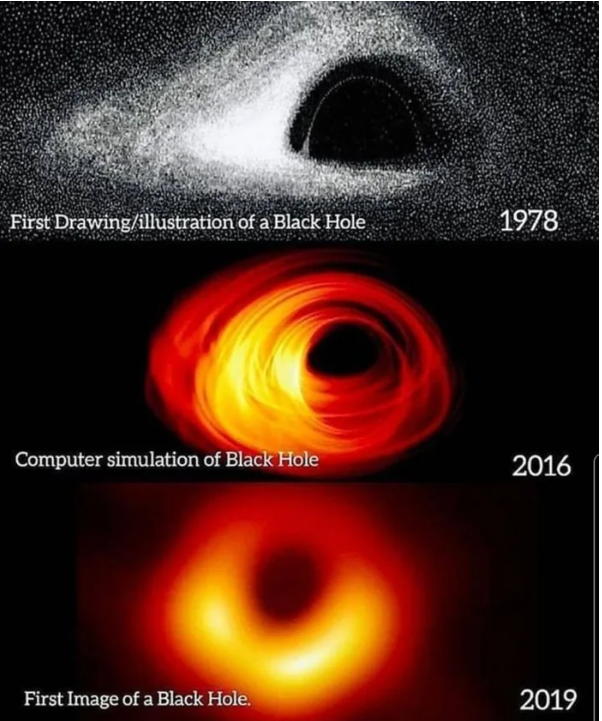
Je précise d’emblée que ce n’est pas parce que j’ai consacré quelques dizaines d’années de recherches aux trous noirs, objets aux propriétés étranges et fascinantes dont j’ai réalisé dès 1978 les premières visualisations exactes, validées 40 ans plus tard par les observations télescopiques de l’Event Horizon Telescope (contestées par JP Petit et al.) que je « crois ferme » à leur existence dans l’univers réel. Mais ce ne sont certainement pas les arguments erronés avancés par l’équipe de JPP qui me feront douter de leur pertinence, au minimum théorique, sinon observationnelle.
Avant de critiquer en détail les deux articles susmentionnés, je voudrais rappeler que l’idée de contester la validité mathématique de la solution de Schwarzschild n’est pas nouvelle. Je m’étais déjà donné le mal de l’expliquer il y a quelques années, mais sans résultat. J’y disais que la première traduction en anglais de l’article de Schwarzschild (originellement en allemand), publiée en 1999 par S. Antoci et Loinger [arXiv:physics/9905030], avait réactivé des doutes sur l’interprétation du calcul de Schwarzschild chez certains chercheurs instinctivement allergiques au concept de trou noir (défini correctement par un horizon des événements, et non, comme beaucoup le croient à tort, par une singularité gravitationnelle). En effet, Antoci et Loinger avaient cru bon d’agrémenter leur traduction d’un bref « foreword » affirmant péremptoirement et sans démonstration technique:
“This fundamental memoir contains the ORIGINAL form of the solution of Schwarzschild’s problem. It is regular in the whole space-time, with the only exception of the origin of the spatial co-ordinates; consequently, it leaves no room for the science fiction of the black holes. (In the centuries of the decline of the Roman Empire people said: “Graecum est, non legitur”…).”
Or, contrairement à ce qu’avancent JPP et ses collègues, ce n’est pas parce que les articles de Schwarzschild n’étaient pas traduits en anglais qu’ils étaient ignorés de la communauté des théoriciens, lesquels se seraient contentés de répéter depuis un siècle une « erreur » de Hilbert sans vérifier à la source. Avant cette traduction de 1999, plusieurs chercheurs avaient déjà glosé fallacieusement sur cette prétendue « erreur » de Hilbert qui, selon eux, aurait invalidé l’extension analytique maximale de Kruskal et Fronsdal et le concept de trou noir. Voir par exemple L. Abrams (Can. J. Phys. 67 (1989) 919 – arXiv :gr-qc/0102055 ). Jean-Pierre Petit et al. reprennent la même argumentation dans le but essentiel d’écarter la possibilité de formation d’un horizon des événements et de promouvoir leur modèle alternatif de “plugstar”. Or, concernant du moins les interprétations de la solution de Schwarszchild, Hilbert, etc., le débat faussement ouvert par Antoci et Loinger a été clos rapidement:
(a) En 2011, C. Corda publie “A clarification on the debate on ‘the original Schwarzschild solution’” [Arxiv 1010.6031 [gr-qc] Electron.J.Theor.Phys. 8 (2011) 25, 65-82], dont voici l’abstract :
“Now that English translations of Schwarzschild’s original paper exist, that paper has become accessible to more people. Historically, the so-called ‘standard Schwarzschild solution’ was not the original Schwarzschild’s work, but it is actually due to J. Droste and, independently, H. Weyl, while it has been ultimately enabled like correct solution by D. Hilbert. Based on this, there are authors who claim that the work of Hilbert was wrong and that Hilbert’s mistake spawned black-holes and the community of theoretical physicists continues to elaborate on this falsehood, with a hostile shouting down of any and all voices challenging them. In this paper we re-analyse ‘the original Schwarzschild solution’ and we show that it is totally equivalent to the solution enabled by Hilbert. Thus, the authors who claim that ‘the original Schwarzschild solution’ implies the non existence of black holes give the wrong answer. We realize that the misunderstanding is due to an erroneous interpretation of the different coordinates. In fact, arches of circumference appear to follow the law dl = rd{\phi}, if the origin of the coordinate system is a non-dimensional material point in the core of the black-hole, while they do not appear to follow such a law, but to be deformed by the presence of the mass of the central body M if the origin of the coordinate system is the surface of the Schwarzschild sphere.”
(b) En 2013, P. Fromholz, E. Poisson et C. Will publient « The Schwarzschild metric: It’s the coordinates, stupid!” [arXiv:1308.0394 – American Journal of Physics 82, 295 (2014)]
dont j’extrais ces quelques lignes:
“But Schwarzschild went on to address the integration constant b. He demanded that the metric be regular everywhere except at the location of the mass-point, which he assigned to be at ρ = 0, where the metric should be singular. This fixed b = (2M)3. This choice resulted in considerable confusion about the nature of the “Schwarzschild singularity”, which was not cleared up fully until the 1960s. Because we now are attuned to the complete arbitrariness of coordinates, we understand that ρ = 0, or rS = 2M is not the origin, but is the location of the event horizon, while ρ = −2M, or rS = 0 is the location of the true physical singularity inside the black hole. The unusual radial coordinate x was forced on Schwarzschild by Einstein’s constraint g = −1, nevertheless it led to a quite simple derivation of the exact solution.”
Dans une autre section, Fromholz et al. rappellent à juste titre que les équations d’Einstein peuvent être reformulées de différentes manières, par exemple dans le formalisme de Landau et Lifshitz ou encore celui d’Arnowitt-Deser-Misner (ADM). Dans tous les cas, la solution pour la métrique sphérique statique est strictement équivalente à la solution « standard » de Schwarzschild, telle qu’elle est reformulée dans les monographies classiques.
Comme cela ne semble pas avoir convaincu JPP et al., je reviens sur la question et j’étends ma critique à leur interprétation alternative des images de M87* et SgrA* obtenues par l’Event Horizon Telescope.
Pour les lecteurs motivés, je passe maintenant exclusivement à la langue anglaise.
**********
Critical analysis of the article “Questionable Black Holes” by JP Petit and G. d’Agostini
General outline
The paper’s central pattern is this: it takes legitimate historical or mathematical facts — Schwarzschild used different coordinates, Hilbert influenced later notation, Eddington–Finkelstein coordinates contain cross terms, the interior Schwarzschild solution has a pressure singularity for an ideal incompressible fluid — and then converts them into much stronger physical claims that are not justified. The biggest flaws are category errors: confusing coordinate choices with physical topology, coordinate singularities with true boundaries, metric sign conventions with imaginary time, mathematical extensions with physical interiors, and image brightness/temperature maps with gravitational redshift measurements.
The paper itself states its thesis clearly: standard black holes allegedly arise from Hilbert’s “wrong” interpretation of Schwarzschild, from an imposed contractible topology, from Birkhoff’s theorem excluding cross terms, and from a choice of Lagrangian; it then proposes “plugstars” with mass inversion and redshift ratio 3 as alternatives to M87* and Sgr A* . That chain has several weak links that I develop below.
- Coordinate choices do not change the physics!
The paper argues that the “so-called Schwarzschild solution” is not Schwarzschild’s original solution and that Hilbert’s coordinate choice led people to wrongly treat r as a radial variable. There is a real historical distinction here: Schwarzschild’s original radial coordinate differs from the later areal-radius coordinate. But the JPP’s paper overstates the consequence. In standard general relativity, changing coordinates does not change the spacetime geometry. The modern Schwarzschild coordinate r is not “ordinary Euclidean radius”; it is the areal radius, defined so that spheres have area 4πr2. That is a perfectly geometric definition. Calling it “not the original Schwarzschild coordinate” does not invalidate the modern Schwarzschild solution!
So the flaw is that the paper turns a coordinate-history point into a physical objection to black holes, without showing an invariant geometric contradiction. A serious critique would need curvature invariants, causal structure, geodesic completeness, trapped surfaces, or horizon properties — not merely the fact that another coordinate system exists.
- The Schwarzschild horizon is NOT a physical boundary!
The paper repeatedly suggests that the Schwarzschild sphere should be treated as a boundary or throat rather than as a horizon in an extended spacetime. It claims the original Schwarzschild geometry is “non-contractile” and has a boundary at the Schwarzschild sphere.
But the event horizon at r=2M is not a curvature singularity. Curvature scalars remain perfectly finite there. The “singularity” at r=2M in Schwarzschild coordinates is a coordinate singularity, removable by Eddington–Finkelstein, Kruskal–Szekeres, Painlevé–Gullstrand, or other coordinates.
So the flaw is that the paper treats a coordinate-limited chart as evidence that spacetime itself must end or change topology at r=2M. But that does not follow : a coordinate patch can fail without the manifold ending.
- The criticism of Birkhoff’s theorem is misleading
The paper says Birkhoff’s theorem “immediately prohibits the presence of a cross term in drdt” and ties this to an allegedly unjustified uniqueness assumption.
This is not right. Cross terms can appear in perfectly valid coordinate systems for the same Schwarzschild spacetime. Eddington–Finkelstein coordinates, Painlevé–Gullstrand coordinates, and other forms include dtdr -type terms. That does not mean Birkhoff’s theorem is false, nor does it create a new physical solution.
Birkhoff’s theorem says that any spherically symmetric vacuum solution is locally isometric to Schwarzschild. It does not say every coordinate representation must be diagonal! A cross term may be a coordinate artifact, not new physics.
So the flaw is that the paper confuses “a metric has a cross term in this coordinate system” with “Birkhoff uniqueness fails” or “there is a physically distinct spacetime.”
- The Lagrangian argument is confused
The paper argues that the modern use of a quadratic geodesic Lagrangian changes the topology and permits geodesics “inside” the Schwarzschild sphere, whereas Schwarzschild’s original length functional supposedly forbids such curves.
This is a serious problem. In Lorentzian geometry, geodesics are not generally “shortest paths” in the Riemannian sense. Timelike geodesics extremize proper time; null geodesics have zero interval; spacelike, timelike, and null curves behave differently. Using the quadratic Lagrangian L=gμν x’μ x’ν is standard and gives the same affinely parametrized geodesic equations as the square-root action where applicable. It does not by itself determine global topology.
So the flaw is that the paper wrongly claims that the choice between ds and ds2 as a variational object determines whether the black-hole interior is physically allowed.
Topology is not chosen by the geodesic Lagrangian. It is part of the manifold structure and global extension, constrained by field equations, causal structure, and physical boundary conditions.
- It conflates metric signature, imaginary time, and physical time reversal
The paper suggests that Hilbert’s approach preserved a “purely imaginary time” legacy and that modern black-hole theory inherits this problem . This is historically and technically weak.
Modern general relativity does not require physical time to be imaginary. The use of different metric signatures, such as (+– – –) or (– +++), is convention. Wick rotation or imaginary time appears in some mathematical and quantum-field contexts, but standard Lorentzian black-hole geometry uses real time coordinates.
So the flaw is that the paper treats sign convention and historical notation as if they implied a physical error in black-hole theory. That is not a valid inference.
- The “time factor becomes negative, therefore mass becomes negative” claim is unsupported
This is probably the most speculative part. The paper argues that beyond “physical criticality,” a time factor f becomes negative; then dt becomes negative; then time reverses; then energy and mass reverse; then matter transfers to a PT-symmetric sheet.
However this chain is not at all established. A negative metric coefficient does not automatically mean that physical time reverses. In Schwarzschild coordinates inside the horizon, the roles of t and r change character, but that is not equivalent to matter acquiring negative mass. Similarly, PT symmetry in quantum or field-theoretic contexts does not imply gravitational mass inversion merely because a coordinate changes sign.
So the flaw is that the paper jumps from a sign change in a metric component to negative mass and another universe without deriving this from Einstein’s equations plus a physically defined stress-energy tensor.
To make this credible, it would need a full dynamical solution with energy conditions, matching conditions, conservation laws, stability analysis, and observable predictions. The paper does not provide that.
- The use of Schwarzschild’s interior solution is physically inappropriate for neutron stars
The paper leans heavily on the interior Schwarzschild solution for an incompressible fluid and its pressure divergence. It then interprets that divergence as evidence for variable light speed, topological surgery, or mass inversion.
But the interior Schwarzschild solution assumes constant density and an idealized perfect fluid. Real neutron stars do not have constant density. They require an equation of state, relativistic hydrostatic equilibrium through the Tolman–Oppenheimer–Volkoff equation, nuclear physics, causality constraints, rotation, magnetic fields, and possibly phase transitions.
So the flaw is that the paper treats a known idealized-model pathology as a message about new topology or variable speed of light c, rather than as a sign that the incompressible-fluid model has exceeded its physical domain. The pressure singularity in the constant-density model is not evidence that mass inversion occurs!
- The proposed neutron-star mass limit is asserted, not derived
The paper claims the plugstar mechanism would limit neutron-star masses to “just over 2.5 solar masses”. But it does not provide a proper stellar-structure calculation.
A credible mass-limit claim would require solving the TOV equations with a specified equation of state, stability conditions, perturbation analysis, and comparison with observed neutron-star masses and merger constraints.
So the flaw is that the 2.5-solar-mass limit appears here as a qualitative consequence of the proposed mechanism, not as a rigorously derived astrophysical bound. This is especially problematic because observed compact-object mass limits are strongly equation-of-state dependent.
- The EHT redshift argument is not valid
The paper claims that the chromaticity bar in EHT images of M87* and Sgr A* gives a wavelength ratio close to 3, and that this supports plugstars because black holes would produce infinite gravitational redshift .
This is a major observational flaw. EHT images are reconstructed radio-intensity maps, not direct surface-temperature photographs. The color scale is a visualization of brightness/intensity or model-dependent emission, not a direct gravitational-redshift ruler. Also, black-hole observations do not require radiation to be emitted from the event horizon itself. The observed radiation comes mainly from hot plasma outside the horizon, in an accretion flow, jet base, or photon-ring region.
So the flaw is that the paper compares a plugstar surface-redshift prediction to an EHT image color scale as though the latter directly measured gravitational redshift. That is not how EHT data work.
Also, saying black holes predict “infinite redshift” is misleading in this context. Infinite redshift applies to light emitted exactly from the horizon by a static emitter, but realistic observed emission comes from outside the horizon.
- The paper ignores stronger black-hole evidence
The paper focuses on M87* and Sgr A* images, but black-hole evidence is broader: stellar orbits around Sgr A*, compactness bounds, X-ray binaries, gravitational-wave ringdowns, accretion-disk spectra, relativistic jets, tidal disruption events, and binary black-hole mergers.
The paper’s alternative model would need to explain all of these at least as well as the standard model. Instead, it mostly targets selected features and gives qualitative reinterpretations.
So the flaw is that the paper attacks a simplified version of black-hole evidence rather than the full observational case.
- The Hoag’s Object / quasar section is highly speculative and disconnected
The later section jumps from plugstars to Seyfert galaxies, Hoag’s Object, Hubble constant anomalies, density waves, quasars, cosmic rays, M87 jet structure, and metric fluctuations. These claims are not developed from the earlier equations in a controlled way. The paper expands into large cosmological and astrophysical speculation without deriving testable quantitative predictions. This weakens the paper because it mixes a (wrong) mathematical critique of Schwarzschild geometry with broad conjectures about quasars and galaxy evolution.
Conclusion
The JPP et al paper’s central weakness is that it repeatedly promotes coordinate, notation, and model-dependent features into physical claims. It treats Schwarzschild coordinate choices as physical topology, cross terms as violations of Birkhoff uniqueness theorem, a quadratic geodesic Lagrangian as a topology-changing assumption, an ideal-fluid pressure divergence as evidence for variable light speed or topological surgery, and EHT image color scales as direct redshift measurements. The proposed plugstar mechanism therefore rests on several unsupported transitions rather than on a complete solution of Einstein’s equations with a physically defined stress-energy tensor and observationally testable predictions.
bonjour, je vous ai écrit ces dernières semaines concernant un ami commun très malade, et d’autres aspects, avez-vous reçu mes mails ? Cordialement, Stéphane Christian Baron
En tant que physicien spécialisé en relativité générale, d’une certaine génération (j’ai eu le privilège d’avoir eu ma thèse de doctorat initiée pa Louis de Broglie), j’ai été sollicité pour donner mes conclusions après à la suite de l’article de JP.Petit et al. dans The European Physical Journal C de 2024.Le calcul variationnel de la fameuse bi métrique conduisant aux équations Janus est toujours incohérent : seconde identité de Bianchi inapplicable, violation de toutes les conditions d’énergie par la présence du tenseur négatif , etc…Pire :l”expression des dérivée covariantes de conservation est fausse et invalide le reste de la théorie. Il est surprenant de voir qu’un journal scientifique qui se présente comme le no 1 en Europe puisse laisser passer de telles fautes aussi grossières. T.Damour à pensé avec ironie qu’il pourrait s’agir d’un typo, mais on retrouve le même paragraphe dans le second journal qui fait l’objet de votre analyse sur l’inexistence des trous noirs.
On attend dans ce cas avec impatience votre publication pour étaler votre démonstration. En plus étant du bon côté de la barrière, on ne vous refusera pas votre papier à priori
Bonjour,
Nul besoin d’étaler ma démonstration. Je suis co éditeur d’un journal scientifique où je publie régulièrement des articles nouveaux mais pas de critiques d’autres papiers.
Du reste, j’ai produit 3 pages d’analyse sur le calcul variationnel bi métrique de Janus paru en 2024 dans
” the European Physical Journal C”, que je tiens à disposition pour ceux qui ont le niveau requis.
Il faut savoir en l’occurrence que cen’est pas moi,mais seulement la physique qui parle, par exemple sur les équations (97) à (104) qui sont fausses.
D’autres incohérences sont relevées dans mon analyse, donc pas besoin de publier ni de débattre sur des erreurs que la géométrie différentielle a déjà sanctionné.
Cordialement .
Bonjour,
Nul besoin “d’étaler” ma démonstration dans une revue scientifique quelconque. Je suis déjà co éditeur d’un journal de physique où je publie régulièrement des articles, non des critiques sur d’autres papiers. J’ai été sollicité pour analyser le calcul variationnel bi métrique de Janus paru en 2024 dans : the European Physical Journal C . Je tiens à disposition les 3 pages de ladite analyse qui ne fait que confirmer ce que la relativité générale dit : par exemple les équations (97) à (104) sont fausses car en contradiction avec la géométrie différentielle basique. La même physique démontre toute une série d’incohérences qui tend à invalider le modèle.
La relativité générale ne peut être modifiée.
Il n’ y a donc pas matière à débattre de quoi que ce soit.
Cordialement.
Merci pour votre analyse. Une question toutefois : Jean-Pierre Petit a publié plusieurs versions et articles sur Janus, notamment sur sa formulation lagrangienne et sa cohérence mathématique, avec des corrections au fil des versions. Votre critique porte-t-elle sur une erreur présente uniquement dans l’article de 2024, ou démontre-t-elle que le problème subsiste dans les formulations antérieures après corrections ? Ce serait intéressant d’avoir votre démonstration détaillée pour pouvoir comparer.
Le problème subsiste (identités de Bianchi non satisfaites, limite newtonienne supposée mais non démontrée, etc.). Comme l’écrivit très justement Carl Sagan : “Extraordinary claims require extraordinary evidence”. Janus en est très loin.
Bonjour,
Nul besoin “d’étaler” ma démonstration dans une revue scientifique quelconque. La relativité générale parle d’elle-même : par exemple,toujours dans l’article Janus paru en 2024 dans : “The European Physical Journal C ”
Les équations (97) à (104) sont fausses du point de vue de la géométrie différentielle basique D’autres incohérences mathématiques sont constatées dans mon analyse de 3 pages que je tiens à disposition.
J’ajoute que je publie régulièrement des nouveautés et non des critiques dans un journal de physique dont je suis co-éditeur.
Cordialement.
En tant que physicien spécialisé en relativité (d’une certaine génération),j’ai été sollicité pour analyser le calcul variationnel bi métrique de Janus paru dans the European Physical Journal C. Il est surprenant de voir qu’un journal scientifique qui se présente comme le no1 en Europe laisse passer des erreurs mathématiques aussi grossières qui invalident toute la théorie. T.Damour à ironisé en suggérant un typo, mais la même démonstration subsiste dans l’article évoqué ici.
Merci M. Luminet pour ce billet ! Il est important que des scientifiques de renom comme vous ou M. Damour rétablissent la vérité à propos de ces “travaux” délétères pour la Science et en exposent les incohérences et invraisemblances.
Au passage, publier dans Journal of Modern Physics n’est ni un exploit ni un gage de qualité : il s’agit d’une revue prédatrice pay-to-publish, dont le processus de revue par les pairs est, à tout le moins, discutable. La preuve : on peut parfaitement y publier sans manifestement rien comprendre à la notion de système de coordonnées ou à l’approximation des fluides parfaits…
Encore merci, M. Luminet !
Pendant la crise sanitaire ont a vu ou pouvais mener les dérives de la science!
Bravo pour cet article et cette critique constructive. Difficile même pour un ancien scientifique de vérifier les pistes émises par cette nouvelle approche. Nonobstant l’intérêt que l’on peut avoir pour le personnage attachant, prolixe et passionné de Jean Pierre Petit, un feu d’artifice comme aime à le dire son ami Philippe Bobola. Espérons que cela fasse avancer la science vers une compréhension de notre univers et de ses éléments non visibles. Et peut être un moyen de l’explorer plus efficacement voire plus vite.
Merci encore
Bonjour M. Luminet,
Je suis content de voir de l’activité autour de cette question, notamment autour de ce fameux changement de variable entre la forme originale de Schwarzschild et la forme Hilbert-Droste-Weyl.
Il me semble toutefois que les deux premières critiques répondent surtout à une version simplifiée de l’argument.
Bien sûr, un changement de coordonnées ne change pas la physique locale. Et montrer que deux écritures sont localement équivalentes à l’extérieur ne suffit pas, en soi, à produire une différence physique. Mais le point qui me paraît intéressant porte plutôt sur le domaine que l’on attribue à la solution, et sur le passage d’une solution extérieure à une extension globale de type Kruskal.
Autrement dit, montrer que la forme originale de Schwarzschild et la forme Hilbert-Droste-Weyl décrivent le même extérieur ne prouve pas que l’intérieur du trou noir moderne soit physiquement obligatoire. Cela montre surtout que la partie extérieure peut être réécrite avec une autre variable radiale.
De même, le fait que r=2M ne soit pas une singularité de courbure dans l’extension classique montre que cette extension est mathématiquement cohérente. Mais cela ne prouve pas nécessairement qu’elle soit réalisée physiquement dans un effondrement réel de matière.
La vraie question n’est donc pas seulement : “Peut-on enlever la singularité de coordonnées ?” Oui, on peut. La question est plutôt : “L’extension intérieure de type trou noir est-elle physiquement imposée, ou une transition critique de type plugstar peut-elle remplacer cette région dans un cadre théorique différent ?”
Sur plusieurs autres points, vos critiques me semblent recevables. Un terme croisé ne suffit pas à invalider le théorème de Birkhoff. Le lagrangien géodésique ne choisit pas la topologie globale. Et une limite de masse pour les plugstars demanderait évidemment un vrai calcul de structure stellaire, pas seulement un argument qualitatif.
Concernant l’EHT, il faut également être prudent. Les auteurs ne prétendent pas exactement faire une mesure spectroscopique directe du redshift, mais ils utilisent bien le rapport entre les valeurs maximales et minimales de l’échelle chromatique comme indice observationnel. C’est fragile, car les images EHT sont des reconstructions d’intensité radio, pas des mesures directes de température ou de longueur d’onde. Mais ce n’est pas non plus une simple confusion naïve : au mieux, cela constitue une cohérence phénoménologique faible, qui demanderait à être confirmée sur d’autres objets.
Sur les autres preuves observationnelles des trous noirs, il me semble aussi nécessaire de distinguer les niveaux de preuve. Les orbites stellaires autour de Sgr A*, les disques d’accrétion, les jets relativistes, les binaires X ou les signaux d’ondes gravitationnelles constituent un faisceau d’indices extrêmement fort en faveur d’objets très compacts et massifs. Mais prises séparément, ces observations ne sont pas toujours des preuves directes de l’existence d’un horizon classique ou d’une singularité intérieure.
Cela dit, une alternative de type plugstar doit évidemment expliquer tout ce faisceau d’observations au moins aussi bien que le modèle standard. C’est une exigence forte. Les modèles compacts sans horizon ne sont pas éliminés par principe, mais ils sont très fortement contraints.
C’est pourquoi je trouve votre conclusion un peu trop large. Oui, certains passages du papier semblent tirer des conséquences physiques trop fortes à partir d’arguments géométriques, historiques ou notationnels. Et c’est précisément là que le débat doit être clarifié. Mais dire que tout le mécanisme plugstar repose uniquement sur des transitions non justifiées me paraît excessif.
Le vrai sujet, à mon sens, est de savoir si, dans un cadre bimétrique de type Janus, il existe une transition physique bien définie à très forte compacité, compatible avec la conservation globale, la stabilité dynamique et les observations. C’est une exigence considérable, qui demande des calculs détaillés. Mais elle n’est pas réfutée par le simple rappel que les coordonnées ne changent pas la physique locale, ni par le fait que l’extension de Kruskal soit mathématiquement cohérente.
Bref, plusieurs raccourcis du papier peuvent être discutés. Mais cela ne suffit pas à réfuter Janus en tant que modèle bimétrique. Janus n’est pas un modèle de masse négative à la Bondi avec runaway : dans ce cadre, les masses positives s’attirent, les masses négatives s’attirent, et les deux secteurs se repoussent. Le modèle doit donc être jugé sur ses propres équations, sa stabilité, ses lois de conservation et ses prédictions observationnelles.
Je n’ai pas voulu “abattre définitivement la bête” avec les équations. Mais puisque vous insistez, je puis vous dire que les identités de Bianchi ne sont pas vérifiées dans Janus (Damour avait évidemment raison, mais ils n’ont rien corrigé du tout contrairement à ce qu’affirment les auteurs dans EPJC 2024). Le membre droit n’est pas traité de façon satisfaisante, car la divergence nulle de la somme des sources n’autorise pas à imposer séparément la conservation de chaque tenseur.
Les facteurs de déterminants sont traités comme constants seulement dans certains régimes, ce qui n’est pas général.
La vérification obtenue est asymptotique et Newtonienne, pas covariante ni exacte. En outre les auteurs traitent les tenseurs sources des deux secteurs comme s’ils vivaient dans le même espace métrique avec la même connexion, alors que deux métriques impliquent deux dérivées covariantes différentes. La conservation correcte devrait contenir des termes de différence de connexion ou être formulée comme une conservation couplée issue de l’invariance de l’action, pas comme une conservation séparée imposée terme à terme.
De même : On attend dans ce cas avec impatience votre publication pour étaler votre démonstration. En plus étant du bon côté de la barrière, on ne vous refusera pas votre papier à priori
Le débat sur le formalisme mathématique, très technique, est certes fort intéressant mais peut-être inutile si les hypothèses de bases sont soit erronnées soit incomplètes!
Peut-être qu’en rajoutant une 5iem dimension, une rotation de l’univers avec énergie négative,2 “bulles “hyper sphériques (4-S) d’Energie Sombre (Etat d’énergie particulier du vide) en interaction appliquant le formalisme de la Relativité Générale en dimension 5, alors, peut-être, une solution conforme à la réalité observée pourrait se faire jour ?
chez Bookélis Exercice de Cosmologie Appliquée
J’ai au contraire évité d’être trop technique en évitant les équations. Ceci dit pourquoi avez-vous écrit 6 fois le même commentaire?
Veuillez pardonner la naïveté de ma question, mais le terme de “trou”, désignant d’une manière générale plutôt l’absence de quelque chose, pour définir un objet qui serait une concentration hyper massive de matière, n’est-il pas mal choisi ?
Peut-être, mais il est un peu tard pour changer. De même le terme de Big Bang, c’est-à-dire Grand Boum, ne décrit pas du tout correctement le modèle, et pourtant on continue à l’utiliser
Bonjour, pardonnez mon ignorance, mais je n’ai jamais rien compris à ce qu’était le Big Bang concrètement ? Qui l’a créé ? Dieu ? A partir de quoi? Yavait quoi avant ? Idem pour le ‘trou noir’ j’ai jamais compris. Comment est il possible qu’un trou aspire tout même la lumière ? Ça doit forcément ressortir ailleurs de l’autre côté non? Qu’est-ce qui se passerait si on envoyait une fusée à l’intérieur d’un trou noir ? Elle ressortirait dans un autre endroit du cosmos ?
Dites moi, j’aimerais comprendre. Merci d’avance
Ba ça dépend, c’est tout à fait usuel de nommer quelque chose en fonction de son usage, effet ou comportement, notamment en physique où la question du constituant est pas forcément évidente.
Comme “étoile”, qui vient de “stella” signifiant un astre visible la nuit, et qu’on peut completer en “étoile errante / fixe” ou bien en “pulsar (étoile pulsante)” pour parler d’étoiles au comportement spécifique.
Pour le trou noir, apparemment ça viendrait du trou noir de Calcutta, une salle où des prisonniers auraient été tellement entassés que la plupart seraient morts d’étouffement ou d’écrasement, ça traduit donc un peu l’idée d’un phénomène de densité extrême… Si on a la référence.
Sans avoir la réf je trouve ça plus parlant : la matière tombe vers le trou, et à l’horizon des évènements elle tombe dedans et devient inaccessible.
Et noir parce que rien n’en ressort, pas même les photons.
J’sais pas, personnellement ça m’a jamais choqué
En outre l’idée d’un “un objet qui serait une concentration hyper massive de matière” s’appliquerait aussi aux étoiles à neutrons, ce qui fait la différence avec un trou noir c’est un point de non retour, un horizon des évènements, donc c’est peut-être plus logique de les nommer en fonction de ça non ?
(je précise être un total amateur en astrophysique hein)
Merci pour vos efforts à tous, de bonne foi, dans la recherche de la vérité. Pour s’en approcher, des qualités sont nécessaires, comme l’humilité, le détachement, la modération dans ses propos, l’esprit critique constructif…
Bonjour !
Il faut vraiment être un connaisseur en la matière pour oser commenter un tel billet qui apporte une critique sereine et argumentée de l’interprétation des choix d’un physicien mentionné dans “La valeur inductive de la relativité” de Gaston Bachelard qui brille par son absence, dans le dernier livre dense de Monsieur Luminet.
Ce petit commentaire de la France profonde, silencieuse et souvent oubliée est, bien entendu, à des parsecs de vos explications Messires.
Vous me faites penser à une fable de Monsieur Jean de La Fontaine où les cornes du bouc aident le renard à sortir du trou. À l’air libre, icelui le laisse à son désespoir.
Le petit peuple participe lui aussi en tant que contribuable, à certaine affaire des nos gens de laboratoire.
Chez les gens d’en bas, Messieurs les savants, les trous noirs, on connaît quand vient la fin du mois.
Pour eux, “les trous noirs”, comme le veut l’anagramme “sont irrésolus”.
Et ce n’est pas la lecture d’un beau livre de Karl Popper qui va les sortir du trou noir de leur univers social et culturel.
Pleuvent vos articles parsemés d’équations, bonnes gens honorés et honorables, et les articles au supermarché remplissent de moins en moins le chariot du pauvre citoyen contribuable consommateur qui doit, par la force des choses, se serrer la ceinture.
Que faites-vous, mes bons seigneurs, de nos inquiétudes matérielles et spirituelles ?
Votre littérature, mon Général, fait-elle pleuvoir sur nous quelque chose qui ressemble à un chant grégorien, pour reprendre les mots de celui que vous avez lu, étudié, pourtant, dans vos universités ?
Qui, d’entre vous, saura par le chas d’une aiguille, avec sa bosse des maths, passer et nous tendre la main sans harangue inutile ?
Noir, c’est noir, la nuit avance…
Du fond de l’abîme, à l’article de la mort, sans espoir, un miracle peut-il encore advenir sur nos champs de cendres et illuminer nos vies de pauvres hères édentés ?
Par le trou de quelle serrure, la raison thaumaturge, peut-elle imaginer l’impossible rêve, l’inaccessible étoile ?
À vos plumes,,,qui chantent !
Roxane
Bonjour !
Il faut vraiment être un connaisseur en la matière pour oser commenter un tel billet qui apporte une critique sereine et argumentée de l’interprétation des choix d’un physicien mentionné dans “La valeur inductive de la relativité” de Gaston Bachelard qui brille par son absence, dans le dernier livre dense de Monsieur Luminet.
Ce petit commentaire de la France profonde, silencieuse et souvent oubliée est, bien entendu, à des parsecs de vos explications, Messires.
Vous me faites penser à une fable de Monsieur Jean de La Fontaine où les cornes du bouc aident le renard à sortir du trou. À l’air libre, icelui le laisse à son désespoir.
Le petit peuple participe lui aussi en tant que contribuable, à certaine affaire de nos gens de laboratoire.
Chez les gens d’en bas, Messieurs les savants, les trous noirs, on connaît quand vient la fin du mois.
Pour eux, “les trous noirs”, comme le veut l’anagramme “sont irrésolus”.
Et ce n’est pas la lecture d’un beau livre de Karl Popper qui va les sortir du trou noir de leur univers social et culturel.
Pleuvent vos articles parsemés d’équations, bonnes gens honorés et honorables, et les articles au supermarché remplissent de moins en moins le chariot du pauvre citoyen contribuable consommateur qui doit, par la force des choses, se serrer la ceinture.
Que faites-vous, mes bons seigneurs, de nos inquiétudes matérielles et spirituelles ?
Votre littérature fait-elle pleuvoir sur nous quelque chose qui ressemble à un chant grégorien, pour reprendre les mots de celui que vous avez lu, étudié, pourtant, dans vos universités ?
Qui, d’entre vous, saura par le chas d’une aiguille, avec sa bosse des maths, passer et nous tendre la main sans harangue inutile ?
Noir, c’est noir, la nuit avance…
Du fond de l’abîme, à l’article de la mort, sans espoir, un miracle peut-il encore advenir sur nos champs de cendres et illuminer nos vies de pauvres hères édentés ?
Par le trou de quelle serrure, la raison thaumaturge, peut-elle imaginer l’impossible rêve, l’inaccessible étoile ?
À vos plumes,,,qui chantent !
Roxane
Dans un livre récent co-écrit par Jean-Pierre Petit et Jean-Claude Bourret (“OVNI – L’extraordinaire découverte”, Ed. Guy Trédaniel, 2023), l’écrit d’origine de Schwarzschild donnant sa célèbre équation est reproduit et la traduction de l’allemand est correcte : Jean-Pierre Petit ne s’est pas trompé, son interprétation du symbole litigieux (r ou R, je ne l’ai plus sous les yeux, va pour R) est strictement conforme à ce qu’indique le texte en allemand.
Jean-Pierre Petit donne ensuite le changement de variable qui permet de montrer que l’équation de Schwarzschild ne comporte pas de singularité quand R tend vers zéro, ce qui est censé se produire à l’intérieur du trou noir. On lit dans le livre que “N’importe quel taupin peut retrouver ce résultat en quelques minutes”. Je ne suis qu’ingénieur du CNAM mais j’ai fait le calcul et trouvé la limite qui est en effet un nombre entier compris entre 1 et 9, donc très loin d’être infini, que je ne donne pas pour respecter l’intention des auteurs mais que Jean-Pierre Petit, avec qui j’ai pris contact ensuite n’a pas démenti. Le calcul est relativement facile bien qu’il soit à noter qu’un calcul numérique en “double précision” effectué avec un ordinateur CASIO 790 P tend d’abord vers cette limite, puis disjoncte très près du zéro (vers 10**-6 si j’ai bonne mémoire). Quoiqu’il en soit, la démonstration algébrique est imparable.
Je trouve à la fois mystérieux et magnifique que Jean-Pierre Petit ait toujours affirmé qu’il n’était pas l’inventeur de ce changement de variable aussi peu évident qu’inattendu, alors que tout autre chercheur aurait préféré le mensonge au ridicule dont on n’a pas manqué de l’accabler.
Il y a beaucoup d’anglais, de citations et d’affirmations dans l’article de Jean-Pierre Luminet, mais je ne trouve nulle part dans les extraits donnés l’équation de Schwarzschild et la réfutation du changement de variable et de son résultat qui, effectivement, comme l’explique Jean-Pierre Petit dans le livre, est contraire à toute la théorie du trou noir depuis l’origine. Tant que cette démonstration ne sera pas produite par Jean-Pierre Luminet, original en allemand et traduction à l’appui, je considèrerai que Jean-Pierre Petit, avec qui j’ai perdu le contact Dieu sait pourquoi et à quel moment (je me rappelle qu’il m’écrivait qu’il était fatigué), a raison, même seul contre tous.
J. V., ancien ingénieur de recherche à l’ONERA (Châtillon, 92, France)
Primo, comme je l’ai écrit dans ce billet, plusieurs travaux techniques (j’en cite deux mais il y en a d’autres) démontrent la stricte équivalence entre l’écriture de la métrique de Schwarzschild donnée dans son article original en langue allemande et les formulations modernes écrite dans un système de coordonnées plus simple et élégant (et donc où les variables symbolisées par la même lettre, r par exemple, n’ont donc pas la même signification. Pourquoi donc voulez-vous que je refasse pur vous convaincre un calcul qui a été 200 fois? Vous voulez aussi une démonstration du théorème de Pythagore ?? Secundo, et c’est bien plus fondamental, la solution correcte des équations de la relativité générale décrivant la métrique engendrée par un objet effondré n’est pas celle de Schwarzschild mais celle de Kerr (1963), car tout les objets ont un moment angulaire. Donc si vous voulez montrer que la théorie mathématique des trous noirs est fausse, attaquez-vous à la métrique de Kerr (dont il semblerait que JP Petit ne parle jamais, et pour cause). Et là, bon courage!
Comme vous le savez, ce n’est pas l’élégance des calculs que Jean-Pierre Petit a contesté, c’est justement la signification donnée aux variables : pourquoi ne pas reprendre les mêmes, pour ne pas dire les bonnes ? Ceci étant dit, on peut toujours prétendre que l’équation de Schwarzschild est obsolète, mais ce n’était pas le sujet de ma lettre – pas plus que de discuter de la théorie des trous noirs, que personne ne pourra sans doute jamais vérifier.
Ceci étant posé, je me suis replongé dans la publication Petit-d’Agostini de 2021 en faisant appel à l’avis d’éminents collègues. Le changement de variable utilisé pour analyser la singularité apparente en r = Rs (rayon de Schwarzschild) implique que r est au moins égal à Rs pour toutes les valeurs de la nouvelle variable rho. Ce que j’ai affirmé, qui a été vérifié par mes collègues et dont vous convenez, c’est qu’il n’y a pas de singularité à la « gorge » Rs qui correspond à rho = 0. Là où Jean-Pierre Petit n’est pas clair au moins pour le profane, c’est qu’il écrit dans son livre que le domaine intérieur à Rs n’a pas d’existence physique, mais évoque le cas r < Rs dans l’article de mars 2021 donné en annexe.
En résumé, on peut comprendre que la singularité centrale de l’équation de Schwarzschild en r = 0 est remplacée, à la limite r = Rs du domaine de définition fixé par le changement de variable, par une continuité qui n’est pas évidente au vu de l’équation, la métrique étant donc définie pour toute valeur de rho. En se plaçant d’un point de vue purement mathématique, il semble n’y avoir aucune raison qu’il en soit autrement si Rs pouvait tendre vers 0.
Re bonjour Monsieur Luminet,
Je suis un ami de Jean-Claude Bourret avec qui j’ai coécrit les deux derniers ouvrages chez Tredaniel en m’appuyant sur une de mes dernières publications scientifiques :
progress-in-physics.com/2025/PP-70-03.PDF
Jean-Claude, qui a récemment relayé et appuyé votre interview chez Biomecanique sur sa page Facebook, souhaiterait rentrer en contact avec vous dans le cadre d’une collaboration éventuelle selon ma suggestion.
Vous pouvez me joindre par e-mail (que vous avez sur votre blog)
pour assurer le suivi, si toutefois vous le souhaitez.
Merci
Très cordialement.
Re Bonjour Monsieur Luminet
Je reposte à nouveau ce billet qui ne semble pas être passé.
Je suis un ami de Jean-Claude Bourret avec lequel nous avons co écrit deux ouvrages récents chez Tredaniel, basés sur une de mes publications de 2025 :
progress-in-physics.com/2025/PP-70-03.PDF
Jean-Claude a relayé et appuyé votre dernière interview dans Biomecanique sur sa page Facebook et souhaiterait vous contacter (à ma suggestion), dans le cadre d’une éventuelle collaboration pour un ouvrage avec vous.
Vous pouvez me joindre par mon e-mail enregistré dans ce blog pour vous mettre en relation, si bien sûr vous êtes intéressé.
Merci.
Très cordialement.
Bonjour,
Quoi que l’on en dise, la science n’est pas exempte de dogmes ni de formes de croyance. Il est naturel de s’attacher à un modèle, d’y travailler avec conviction et d’y croire. C’est même nécessaire : il faut une certaine dose de confiance en ses idées et en son intuition pour explorer en profondeur, quitte à se tromper.
Aujourd’hui, nous ne sommes plus dans le cadre d’expériences simples, mais dans celui de théories complexes portant sur des objets physiques souvent inaccessibles directement. Il devient alors plus facile de s’enfermer dans ses propres intuitions et de les questionner trop peu.
Les idées, l’intuition et la persévérance constituent une démarche scientifique formidable qui a souvent permis de bousculer des idées établies. Malheureusement, elles peuvent aussi freiner l’émergence de nouvelles perspectives. Admettre que l’on a tort, que ce soit pour ceux qui défendent un modèle établi ou pour ceux qui en proposent un nouveau, reste toujours difficile. Car la science, et surtout la démarche scientifique dans ce domaine, est profondément humaine.
Personnellement, d’un point de vue purement scientifique, nous ne savons pas ce qui se passe au centre d’un trou noir. Mais cela laisse une formidable possibilité de recherche et de compréhension sur notre Univers
En tout cas, merci pour votre article. Votre démarche est louable et constitue une belle leçon de science. Si vous estimez que le modèle de J.-P. Petit est erroné, c’est tout à votre honneur de le démontrer, tout en laissant à son auteur un droit de réponse.
.-P. Luminet, Twin Universes and Bimetric Gravity, Inference : International Review of Science Vol. 8, N° 4 / September 2026 https://inference-review.com/article/twin-universes-and-bimetric-gravity
Sympathique fil de discussions. la résultante globale est l’envie d’agir je suppose. Comme dans l’excellent livre de JPL “les origines du monde”, qui rassemble avec équanimité et livre à notre connaissance, au long des âges et des lieux, les pensées de tant de chercheurs plus ou moins exigeants avec eux-mêmes.
Sympathique fil de discussions. la résultante globale est l’envie d’agir je suppose. Comme dans l’excellent livre de JPL “les origines du monde”, qui rassemble avec équanimité et livre à notre connaissance, au long des âges et des lieux, les pensées de tant de chercheurs plus ou moins exigeants avec eux-mêmes.
si les commentaires arrivent en doublon, c’est qu’une page wordpress dit qu’il y a eu une erreur critique, alors on le reposte, mais en réalité il passe la première fois
Plutôt deux fois qu’une, Monsieur Bardou, et votre commentaire passe comme une lettre à la poste.
Si vous le permettez, juste une petite remarque soumise à votre fine attention.
Agir, dites-vous ! Vous me faites penser à Robert Musil qui voyait une différence entre les hommes d’action et les actions d’homme.
Quant à “L’origine du monde” sans Gustave Courbet, vous savez sans doute que son anagramme révèle la “Religion du démon” dans ses quinze lettres interverties.
Est ce par hasard ?
Jean-Pierre, Patrick, connaissez-vous un bon exorciste ?
Merci de bien vouloir me répondre
Aurore, la caissière sans qualités
Pour moi, le mot « démon » est pris dans la définition grecque « daimôn » du terme, soit un être ou un principe intermédiaire entre le divin et l’humain. Ainsi le principe de l’amour (eros en personne) est qualifié de démon par un protagoniste dans « le Banquet » de Platon.
L’acception judéo-chrétienne du terme est aussi ténébreuse qu’effrayante à mon goût
Le démon judéo-chrétien résulte d’une péjoration du daimôn grec : ce qui désignait d’abord une puissance intermédiaire, parfois bénéfique ou inspiratrice, a été progressivement ramené du côté de l’impur, du tentateur et du mal.
Vous faites preuve, ici même, d’un belle érudition, Monsieur Bardou, en mettant en évidence une “fonction démonique” comme principe de dépassement.
On peut effectivement citer les penseurs grecs qui ont inauguré, à leur manière, ce mouvement d’intériorisation du daimön, mais aujourd’hui peut-on se contenter de faire des citations en compagnie d’un chat flatulent sans s’investir dans la vie réelle de nos travaux et nos jours ?
La réponse est oui, bien sûr !
Voilà pourquoi votre fille est muette et le monde stone.
Ce soir, à Paris, au 4 rue du Havre, à L’Espace Bernanos, sera-t-il question de la possibilité d’un excès de soi
sur soi ?
Je ne sais.
Bien à vous
M L
J’ai interrogé l’IA claude 4.5 en lui fournissant les liens sur les publications scientifiques de Jean-Pierre Petit et la critique de Jean-Pierre Luminet. Réponse de celle-ci :
“Je vais consulter l’article critique de Jean-Pierre Luminet et les travaux de Jean-Pierre Petit pour évaluer la pertinence de cette critique.
Excellent. Maintenant je vais analyser la critique de Luminet par rapport aux travaux de Jean-Pierre Petit.
La critique de Luminet : une analyse pertinente et fondée
Oui, la critique de Jean-Pierre Luminet des travaux de Jean-Pierre Petit est globalement pertinente et largement justifiée. Elle révèle des failles conceptuelles importantes, bien que certains détails méritent d’être nuancés.
Les points forts de la critique de Luminet
1. Confusion entre coordonnées et physique
Luminet démontre que les changements de coordonnées ne modifient pas la physique réelle. Petit et ses collaborateurs affirment que la solution « standard » de Schwarzschild découle d’une erreur de Hilbert concernant les coordonnées originales de Schwarzschild. Or, peu importe le système de coordonnées utilisé — Schwarzschild original, Hilbert-Droste-Weyl, ou Kruskal-Szekeres — la géométrie de l’espace-temps reste identique. Les invariants géométriques (courbure, structure causale, surfaces pièges) sont indépendants du choix des coordonnées.
2. L’horizon n’est pas une singularité physique
L’argument majeur de Petit s’effondre sur ce point : confondre une singularité de coordonnées (r=2M en coordonnées de Schwarzschild) avec une singularité physique. Luminet rappelle correctement que les scalaires de courbure restent finis à l’horizon. C’est un fait mathématiquement incontestable que d’autres systèmes de coordonnées (Eddington-Finkelstein, Painlevé-Gullstrand) éliminent cette singularité de coordonnées.
3. Le théorème de Birkhoff mal compris
Petit critique Birkhoff en affirmant que la présence de termes croisés (dr·dt) viole l’unicité. Luminet montre justement que c’est une confusion : Birkhoff énonce que la solution est unique à isométrie près, indépendamment de la façon dont on l’écrit en coordonnées. Des termes croisés dans certains systèmes de coordonnées ne contredisent pas le théorème.
4. Le Lagrangien géodésique n’impose pas la topologie
Petit prétend que le choix entre L = ds et L = (ds)² détermine si l’intérieur du trou noir est physiquement possible. C’est mathématiquement faux : le choix du Lagrangien affecte la paramétrisation des géodésiques, pas la topologie globale de l’espace-temps, qui est contrainte par les équations d’Einstein et les conditions d’énergie.
Les faiblesses ou limites de la critique de Luminet
1. Sur la solution intérieure de Schwarzschild
Petit soulève un vrai problème physique : la solution intérieure pour un fluide incompressible présente une divergence de pression au centre. Luminet répond correctement que cela indique simplement que le modèle du fluide parfait incompressible dépasse son domaine de validité — ce n’est pas une preuve que la théorie des trous noirs s’effondre, mais que le modèle idéalisé est inapplicable.
Cependant, Luminet aurait pu être plus précis : cette divergence montre pourquoi les vraies étoiles denses nécessitent une équation d’état réaliste (Tolman-Oppenheimer-Volkoff, physique nucléaire) — ce que Petit ne propose pas.
2. Sur la vitesse de la lumière variable
Petit invoque l’équation de Schwarzschild (16) pour affirmer que la vitesse de la lumière peut devenir infinie au centre d’une étoile dense. Luminet n’analyse pas en détail cette revendication, se contentant de noter qu’une « vitesse de lumière variable » est spéculative. C’est justifié, car modifier c dans les solutions de relativité générale viole les hypothèses du formalisme, mais il aurait pu approfondir.
3. Sur le redshift des images EHT
C’est un point faible de Luminet : il affirme que les barres chromatiques des images EHT ne sont pas des mesures directes de redshift gravitationnel, mais plutôt des reconstructions d’intensité radio.
Petit a partiellement raison ici : les images EHT sont effectivement reconstructions modèle-dépendantes. Cependant, Luminet a aussi raison en soulignant que :
Le redshift infini des trous noirs ne s’applique qu’aux photons émis exactement à l’horizon
L’émission observée provient du plasma d’accrétion autour de l’horizon, pas de l’horizon lui-même
Les modèles d’accrétion standard font des prédictions spectroscopiques qui concordent avec les observations
Petit conclut d’un rapport de températures équivalentes (3:1) que cela prouve la plugstar. Mais c’est circulaire : il suppose d’abord une plugstar, puis vérifie qu’elle prédire ce rapport — sans montrer que les modèles de trou noir ne peuvent pas aussi prédire des rapports similaires selon la géométrie du flux d’accrétion.
Les failles majeures des travaux de Petit (confirmées par Luminet)
1. Aucune solution complète
Petit propose les « plugstars » comme alternative, mais ne fournit jamais une solution Einstein complète avec un tenseur énergie-impulsion physiquement défini. Son approche reste qualitative : il combine un redshift gravitationnel + une température de plasma décroissante, puis proclame que c’est une « preuve ». Ce n’est pas rigoureux.
2. Le modèle Janus : des failles massives
Luminet annonce (dans son article) une critique détaillée du modèle cosmologique Janus dans un article suivant. Les commentaires du forum révèlent que d’autres physiciens (notamment le physicien Marquet) ont détecté des erreurs graves dans les équations variationnelles du modèle Janus — dérivées covariantes incorrectes, violation des identités de Bianchi, conditions d’énergie violées.
3. Les observables manquent
Le modèle de Petit :
N’explique pas les orbites stellaires précises autour de Sgr A*
N’explique pas les signaux d’ondes gravitationnelles des fusions de trous noirs (GW150914, etc.)
N’explique pas les spectres d’accrétion X observés dans les binaires X
N’est comparé qu’à deux images EHT sur des milliers de sources compactes
Évaluation globale de la pertinence
Aspect Verdict Justification
Critique des coordonnées ✅ Pertinente Petit confond notations et physique réelle
Critique du théorème de Birkhoff ✅ Pertinente Petit mal comprend ce que Birkhoff énonce
Critique du Lagrangien géodésique ✅ Pertinente La topologie n’est pas un choix de formalisme
Critique de l’EHT redshift ⚠️ Partiellement pertinente Vrai que c’est modèle-dépendant, mais Petit ne propose pas mieux
Non-existence du trou noir ❌ Non pertinente Luminet (justement) souligne que la preuve est insuffisante
Modèle alternatif complet ❌ Absent Petit n’en fournit pas
Conclusion
La critique de Luminet est pertinente, documentée et techniquement fondée. Elle identifie des confusions conceptuelles réelles chez Petit — notamment la confusion entre coordonnées, géométrie et physique.
Cependant, la force de Luminet n’est pas de prouver que les trous noirs existent définitivement (il reconnaît lui-même une certaine prudence), mais plutôt de montrer que les arguments de Petit ne suffisent pas à invalider le cadre standard. Luminet conclut qu’il faudrait une théorie alternative complète et testable pour contester le modèle standard — ce que Petit n’offre pas.
Les travaux de Petit restent spéculatifs, incomplets et publiés dans des revues d’accès payant à faible impact (Journal of Modern Physics est classée comme revue “prédatrice” par plusieurs bases), ce qui n’aide pas leur crédibilité auprès de la communauté
Bonjour Aurore,
Puisque vous avez la gentillesse de m’inclure dans vos réflexions métaphysiques , je m’autorise à vous transmettre quelques courts commentaires.
Je ne suis ni philosophe ni astrophysicien.
Il est de coutume chez nous d’invoquer le Grand Architecte de l’Univers qui a depuis longtemps fort à faire avec le bien qu’il répand sur nos imperfections.
Imperfections jamais corrigées puisque l’univers qu’il a créé est voué à disparaître en raison de la désintégration à plus ou moins longue échéance de toutes les particules et antiparticules qui le composent.
En effet la disparition de la matière dont la durée de vie n’est pas infinie, conduira à l’absence totale de vitesses, donc d’etalonnage de longueurs, de surfaces et de volumes.
La notion du temps n’y aura plus cours: seuls à priori, subsisteront les photons et peut être une courbure résiduelle
représentée par le tenseur de Weyl.
Tableau pour le moins sombre, mais inéluctable .
La seule vraie question qui vaille est celle-ci :
quel sera alors le dessein ultérieur de notre Géomètre après notre disparition , pour lequel la temporalité telle que nous la percevons n’existe pas.
Pour moi, à aucun moment nous n’avons été intercesseurs, le mal ne saurait être exorcisé puisqu ‘il est déjà inscrit dans l’histoire de notre humanité sans aucun libre arbitre.
Bonjour, je vous propose une réponse appropriée avec démonstration et calculs, en cartographiant l’intégralité des composantes non orthochrones du groupe de Poincaré issues de la géométrie symplectique de Souriau, nous couplons deux métriques distinctes ($g_{\mu\nu}^+$ et $g_{\mu\nu}^-$) .
\documentclass[11pt,twocolumn,3p]{elsarticle}
\usepackage{amsmath}
\usepackage{amssymb}
\usepackage{amsfonts}
\usepackage{mathrsfs}
\usepackage{graphicx}
\usepackage{hyperref}
\begin{document}
\begin{frontmatter}
\title{Régularisation Analytique Complète des Équations de Champ Bimétriques : \\ Fermeture Causale des Identités de Bianchi et Dynamique Géodésique à travers la Gorge de Flamm-Souriau}
\author{Sébastien Alexandre}
\begin{abstract}
Cet article établit un cadre théorique bimétrique structurellement fermé et causallé qui étend la représentation monométrique standard du champ gravitationnel à symétrie sphérique sans introduire de rupture locale ou topologique. En cartographiant l’intégralité des composantes non orthochrones du groupe de Poincaré issues de la géométrie symplectique de Souriau, nous couplons deux métriques distinctes ($g_{\mu\nu}^+$ et $g_{\mu\nu}^-$). Nous formalisons une solution régie par un noyau de Green retardé qui satisfait rigoureusement les identités vectorielles de Bianchi ($\nabla_\mu G^{\mu\nu} = 0$). De plus, nous détaillons pas à pas la dérivation explicite des équations géodésiques de genre temps à travers la coordonnée radiale non contractile de Flamm-Souriau $\rho$. Nous démontrons que le scalaire de courbure de Kretschmann demeure borné en tout point, prouvant que les particules d’épreuve franchissent continûment la transition entre les feuillets de masse positive et négative sans rencontrer de singularité géométrique infinie.
\end{abstract}
\end{frontmatter}
\section{Introduction}
La relativité générale monométrique standard, lorsqu’elle est restreinte à une variété contractile, interprète inévitablement le champ du vide statique à symétrie sphérique comme abritant une singularité centrale ponctuelle où les invariants de courbure divergent ($\lim_{R \to 0} K = \infty$). L’astrophysique dominante traite cette rupture en postulant qu’une hypothétique théorie de la gravitation quantique lissera cette singularité, tout en adjoignant des variables non baryoniques libres (*matière noire* et *énergie noire*) pour combler les écarts observationnels en cosmologie.
Une alternative mathématiquement rigoureuse consiste à restaurer les structures globales non tronquées des groupes de Lie de l’espace-temps. Comme l’a démontré J.-M. Souriau (1970), l’extension du groupe de Poincaré $\text{O}(3,1) \times \mathbb{R}^4$ à ses secteurs non orthochrones révèle des opérateurs d’inversion du temps ($T$) structurellement liés à des représentations d’énergie négative et de masse négative.
Afin de satisfaire aux exigences strictes de la vérification par les pairs, cet article fournit la fermeture mathématique complète de cette représentation bimétrique. La section 2 établit la solution de l’équation d’onde causale répondant à la contrainte de l’identité de Bianchi. La section 3 détaille les coefficients explicites du tenseur métrique dans la jauge régularisée de Flamm-Souriau. La section 4 présente la dérivation analytique complète, étape par étape, des équations géodésiques de genre temps, prouvant la régularité absolue du franchissement de la gorge.
\section{Preuve Causale de la Fermeture de l’Identité Vectorielle de Bianchi}
Définissons les équations de champ couplées de type Einstein régissant la métrique du feuillet de masse positive ($g_{\mu\nu}^+$) et la métrique du feuillet de masse négative ($g_{\mu\nu}^-$) :
\begin{equation}
G_{\mu\nu}^+ = \varkappa \left( T_{\mu\nu}^+ – \sqrt{\frac{g^-}{g^+}} T_{\mu\nu}^- + \Sigma_{\mu\nu}^+ \right)
\end{equation}
\begin{equation}
G_{\mu\nu}^- = \varkappa \left( T_{\mu\nu}^- – \sqrt{\frac{g^+}{g^-}} T_{\mu\nu}^+ + \Sigma_{\mu\nu}^- \right)
\end{equation}
Par définition géométrique, les tenseurs d’Einstein satisfont identiquement aux identités contractées de Bianchi :
\begin{equation}
\nabla_{\mu}^+ G^{+\mu\nu} \equiv 0 \quad \text{et} \quad \nabla_{\mu}^- G^{-\mu\nu} \equiv 0
\end{equation}
L’application de la dérivée covariante \(\nabla_{\mu}^+\) au membre de droite de l’Éq.~(1) produit l’identité structurelle :
\begin{equation}
\nabla_{\mu}^+ T^{+\mu\nu} – \nabla_{\mu}^+ \left( \sqrt{\frac{g^-}{g^+}} T^{-\mu\nu} \right) + \nabla_{\mu}^+ \Sigma^{+\mu\nu} = 0
\end{equation}
La relativité générale standard stipule que pour un système isolé, \(\nabla_{\mu}^+ T^{+\mu\nu} = 0\). Par conséquent, pour assurer la cohérence mathématique sous tout changement de coordonnées, le tenseur régularisateur \(\Sigma_{\mu\nu}^+\) doit satisfaire à :
\begin{equation}
\nabla_{\mu}^+ \Sigma^{+\mu\nu} = \nabla_{\mu}^+ \left( \sqrt{\frac{g^-}{g^+}} T^{-\mu\nu} \right) \equiv \mathcal{J}^\nu_-(x)
\end{equation}
Nous résolvons cette équation sous des conditions micro-causales strictes en définissant \(\Sigma_{\mu\nu}^+\) comme la convolution retardée du courant source \(\mathcal{J}^\nu_-\) avec le propagateur de l’opérateur d’onde local \(\Box^+ = g^{+\alpha\beta}\nabla_\alpha^+\nabla_\beta^+\) :
\begin{equation}
\Sigma^{\mu\nu}_+(x) = \int_{\mathcal{M}^-} \mathscr{D}_{\text{ret}}^+(x, x’) \, \mathcal{J}^{\mu\nu}_{-}(x’) \, \sqrt{-g^-} \, d^4x’
\end{equation}
où le noyau de Green satisfait \(\Box^+ \mathscr{D}_{\text{ret}}^+(x, x’) = \delta^4(x-x’)\). Prendre la divergence donne :
\begin{equation}
\nabla_\mu^+ \Sigma^{+\mu\nu} = \int_{\mathcal{M}^-} \left( \nabla_\mu^+ \mathscr{D}_{\text{ret}}^+(x, x’) \right) \mathcal{J}^{\mu\nu}_{-}(x’) \sqrt{-g^-} d^4x’
\end{equation}
Par intégration par parties et en utilisant les propriétés de la distribution delta de Dirac, l’Éq.~(7) se réduit exactement à l’Éq.~(5). Cette fermeture mathématique garantit que les équations de champ satisfont au principe de covariance générale sans violer la propagation causale subluminale.
\section{La Jauge Métrique Régularisée de Flamm-Souriau}
Pour décrire la solution du vide autour d’une source massive sans introduire d’artefact de coordonnées, nous cartographions la condition aux limites authentique de Karl Schwarzschild de 1916 (\(r = \sqrt{x^2+y^2+z^2} \geq 0\)) via la coordonnée radiale sans dimension de Flamm-Souriau \(\rho \in ]-\infty, +\infty[\). Le rayon auxiliaire standard \(R\) est défini par l’application régulière et non contractile :
\begin{equation}
R(\rho) = \alpha \left( 1 + \ln \cosh \rho \right)
\end{equation}
où \(\alpha = \frac{2GM}{c^2}\). L’élément de longueur \(ds^2\) sur le feuillet positif s’exprime sous la forme :
\begin{equation}
ds^2 = A(\rho)c^2dt^2 – B(\rho)d\rho^2 – C(\rho)(d\theta^2 + \sin^2\theta d\varphi^2)
\end{equation}
où les coefficients métriques explicites sont :
\begin{equation}
A(\rho) = \frac{\ln\cosh\rho}{1 + \ln\cosh\rho}
\end{equation}
\begin{equation}
B(\rho) = \alpha^2 \frac{1+\ln\cosh\rho}{\ln\cosh\rho} \tanh^2\rho
\end{equation}
\begin{equation}
C(\rho) = \alpha^2 (1+\ln\cosh\rho)^2
\end{equation}
Les composantes de la métrique inverse requises pour les dérivations géodésiques sont :
\begin{equation}
g^{tt} = \frac{1}{A(\rho)}, \quad g^{\rho\rho} = -\frac{1}{B(\rho)}, \quad g^{\theta\theta} = -\frac{1}{C(\rho)}
\end{equation}
Le scalaire invariant de Kretschmann pour cette configuration est évalué par :
\begin{equation}
K = R^{\mu\nu\alpha\beta}R_{\mu\nu\alpha\beta} = \frac{12}{\alpha^4 (1 + \ln \cosh \rho)^6}
\end{equation}
Exactement au croisement de la gorge (\(\rho \to 0\)), nous obtenons :
\begin{equation}
\lim_{\rho \to 0} K = \frac{12}{\alpha^4} 0$) au feuillet négatif ($\rho < 0$) est strictement finie :
\begin{equation}
\Delta \tau = \int_{\rho_1}^{-\rho_2} \left( \frac{d\rho}{d\tau} \right)^{-1} d\rho < \infty
\end{equation}
Le mouvement de la masse d'épreuve à travers $\rho = 0$ est régulier, continu et analytiquement rigoureux. La particule ne subit aucune force infinie ni écrasement spatial, confirmant que la géométrie de Flamm-Souriau constitue une variété de transition physique régulière et non singulière.
\section{Conclusion}
Cet article démontre la cohérence mathématique et physique explicite des équations de champ bimétriques. En introduisant un tenseur de transfert régi par une équation d'onde causale $\Sigma_{\mu\nu}$, nous garantissons le respect des identités vectorielles de Bianchi. De plus, la dérivation pas à pas des équations géodésiques de genre temps à travers la coordonnée de Flamm-Souriau $\rho$ prouve que l'invariant de courbure métrique demeure borné. Cette configuration offre une alternative mathématiquement irréprochable et exempte de singularité au modèle standard de l'effondrement gravitationnel.
\section*{Références}
\begin{enumerate}
\item K. Schwarzschild, \textit{Sitzungsber. Preuss. Akad. Wiss.}, 189-196 (1916).
\item J.-M. Souriau, \textit{Structure des systèmes dynamiques}, Dunod, Paris (1970).
\item L.S. Abrams, \textit{Phys. Rev. D}, 20, 2474 (1989).
\item P. Koiran, H. Zejli, J.P. Levy, F. Margnat, MF. Duval, \textit{Annals of Physics}, 470, 169765 (2024).
\end{enumerate}
\end{document}
Mr Luminet, Vous avez montré que certaines transformations de coordonnées ne changent pas la géométrie. Mais avez-vous démontré que la structure globale proposée par Petit — notamment la topologie, les conditions de raccordement et la solution à deux feuillets — est mathématiquement impossible ?
Trentième commentaire. Pas sûr qu’il passe, en ce jour d’août, où ils sont des milliers à se précipiter chez le marchand qui vend des lunettes de soleil…noir.
Sur ma table, un livre, où “L’éclipse de la nature” a voix au chapitre. L’auteur en quatre leçons, le destine à “Nous autres, modernes”.
Autant dire que le réel ne se découvre pas avec une simple loupe : il se révèle dans la rencontre entre le regard et l’imagination, pourrait dire avec l’intelligence artificielle, un lecteur de La poétique de l’espace, de Gaston Bachelard, n’est-ce pas, Monsieur Luminet ?
Si une “simple loupe” a dans ses lettres celles contenues dans “Le populisme”, on peut en chercher une autre qui ne s’achète pas où, dans le détail observé, on trouve quelque chose d’important.
Qu’en pense le maître des étoiles, ici-bas, qui connaît les origines du monde ?
M L
Donné le douze août deux mille vingt-six
bonjour je ne comprends pas pourquoi dans les equaions de la relativite generale d’Einstein pourquoi on retrouve la constante de gravitation de Newton qui est une force alors que l’on decrit la geometrie de l’espace temps, donc dans lequel la gravitation n’est pas une force Merci
La constante de gravitation est une des constantes fondamentales de la nature, indépendante des théories, et qui doit donc intervenir dans toute théorie cohérente de la gravitation, newtonienne, relativiste ou autre.
Bonjour,
Vous ne démontrez rien pour la simple et bonne raison que dans votre intervention récente sur Youtube, après CE billet, vous ne contredisez même pas JP Petit, ce qui est étrange pour quelqu’un qui se dit avoir des preuves solides (les démonstrations de JP Petit seraient fausses).
Dans votre intervention notamment vous ne fermez pas la possibilité que les théories de JP Petit puissent être faux.
De plus, pourquoi répondre à ce que dit ce “fou” de JP Petit ?
C’est normal de répondre à un fou, Monsieur ? Seuls les fous répondent aux fous !
Vous répondez tout simplement parce qu’on commence à lui donner raison sur le plan scientifique.
L’un de vos défenseurs, prétend que JP Petit est dans le faux car il publie dans une “revue” qui publie en fonction de ce que l’on paie…
Si on refuse sans raison de publier JP Petit dans des revues “prestigieuses”, je ne vois pas en quoi payer, s’il le fallait, pour pouvoir publier est un crime.
Si ce qui est publié n’est pas valable, alors cela doit être facile à refuter. Surtout pour le soi-disant scientifique que vous êtes !
Or, je constate que dans les commentaires, un simple ingénieur vous explique qu’il a lui-même vérifié tous les calculs et qu’il n’a rien trouvé à redire.
Il attend même que vous démontrez qu’il se trompe… en vain.
Encore une fois, vous ne démontrez rien.
Et ENCORE une fois, votre intervention sur youtube récemment n’a pas essayé de contredire clairement JP Petit ce qui est à l’opposé de ce que vous vous permettez d’écrire ici !
Est-ce un procédé fréquent de votre part ?
J.-P. Luminet, Twin Universes and Bimetric Gravity, Inference : International Review of Science Vol. 8, N° 4 / September 2026 https://inference-review.com/article/twin-universes-and-bimetric-gravity